
Magician course: how to choose the right one
By Maxime Henry·· 12 min read
Choosing a magician course means, first of all, choosing a way to learn: books, free videos, a club, in-person lessons, an online course or mentoring. In this guide I compare these six paths honestly, I give you the criteria of a good magic course and the red flags to watch for. You’ll know what to learn first, how much time to put in and which option really fits your plans.
Which magic course should you choose to become a magician? The short answer
There’s no single best magician course. There’s the right course for you, depending on what you want to do with magic. Before you compare anything, answer three questions:
- Who do you want to perform for? For the people close to you, to liven up a party, or for a living.
- How much time can you put in? A few minutes a day, or several hours a week at set times.
- How do you learn best? By reading, by watching a video you can pause, or with someone there to correct you.
Here’s my advice in short:
- You just want to try it out: free videos and a free course are enough to find out if you like magic.
- You want a solid base, at your own pace: a well-built online magic course, from beginner to advanced, that you follow with a deck in your hands.
- You want to meet other magicians and perform for a friendly audience: add a club or an association near you.
- You want to do it for a living: mentoring with personal follow-up, with a magician who really performs for audiences and who corrects you.
I sell online magic courses myself, so let me be clear: keep a critical eye. The criteria in this article apply to every course, mine included.
Books, YouTube, clubs, lessons or mentoring: the 6 ways to learn magic
Magic books
The great books of magic are the foundation of everything. Many techniques we still use today were described in them decades ago.
- Pros: incredibly rich content, often written by great magicians, for a lot less money than a course.
- Cons: a move described in writing is hard to understand when you’re starting out. You don’t see the rhythm, the angle or the way of speaking.
Books become valuable once you have some basics and can “read” the description of a move.
Free YouTube videos
Many people start there, and that’s where I started too. You’ll find thousands of tricks explained without paying a thing.
- Pros: it’s free, you see the moves and you can try tons of styles to find out what you like.
- Cons: there’s no order. You jump from one trick to another without building a base. The tricks people post are often ones everybody knows, and most videos give you the secret without teaching you how to present the trick. And nobody answers your questions.
Magic clubs and associations
In many cities, amateur and professional magicians meet in a club or an association, often one evening a week or a month.
- Pros: you meet other enthusiasts, you see tricks live, you present yours to people who understand and you get direct advice. It’s also a great way to stay motivated.
- Cons: they’re not everywhere, the schedule is fixed and the members’ level varies a lot. It’s not always an organized path from beginner to advanced: you mostly learn by watching and asking.
In-person magic lessons
Some magicians teach in person, one-on-one or in small groups, for a few sessions or a whole year.
- Pros: someone sees your hands and corrects your moves on the spot. Nothing improves your technique more.
- Cons: it’s usually the most expensive format per hour, you have to travel and the group moves at everyone’s pace. Once the session is over, you can’t rewatch the move you missed.
Online magic courses, on video
An online course is a set of videos in a clear order that you watch at home, whenever you want.
- Pros: a clear path, from the simplest to the most advanced. You pause, rewind, watch the move ten times, with a deck in your hands. You go at your own pace, and you often get far more hours of content than with in-person lessons, for less money.
- Cons: nobody sees you do it, so you have to film yourself to correct yourself. It takes a bit of discipline. And quality varies hugely from one course to the next, which is why I give you the criteria below.
One-on-one mentoring
With mentoring, an experienced magician guides you personally for several weeks or several months.
- Pros: advice made for you, corrections on your actual tricks and, often, help with the professional side: finding clients, putting together a show.
- Cons: it’s the biggest investment, in money and in time, and spots are limited. To do magic for friends, it’s usually more than you need.
If you’re not sure yet that you want to invest, start by trying it for free: my free course gives you 7 videos right away, with professional tricks explained step by step.
Free course7 easy, impressive pro tricks7 tricks explained on video, free, available right away. With an English voice.Get the free courseWhat makes a good magic course?
Whether you choose an online magic course or in-person lessons, here are the 8 points I’d check before paying.
A progression from beginner to advanced
A good course starts with simple tricks that work quickly, then adds techniques one by one. If everything is at the same level, or if you don’t know where to start, it’s not a course: it’s a collection of tricks.
Tricks with everyday objects
A normal deck, a bill, a borrowed object. Trick props have their place, but if every trick makes you buy a new accessory, you’ll never be able to do magic on the spot.
The method and the presentation
The secret of a trick is half the work. The other half is what you say, where you look, when you slow down to misdirect. A good course explains both. Otherwise, you know the trick, but it falls flat when you perform it.
Clear videos you can rewatch
Several camera angles, a sharp picture, moves shown slowly and then at normal speed. And above all, the option to pause and rewatch as many times as you want.
Lifetime access and updates
You learn magic over months. Access limited to a few weeks forces you to rush. Look for lifetime access and, if possible, new tricks added over time.
A teacher who really performs for audiences
Someone who presents their tricks to real spectators knows what works, what fails and how to save a mistake. Check whether they show their tricks in real situations, and not only in front of their camera.
Help when you get stuck
An email that gets answered, a student group, a place to ask your questions. When you’re alone with a move that won’t work, it’s easy to give up.
A guarantee
A serious course dares to tell you: if you’re not happy, you get your money back. Read the conditions carefully before you buy.
Red flags before you buy an online magic course
There are lots of online courses, and they’re not all worth the same. Be wary if you see:
- “Become a professional magician in 7 days.” You can learn a good trick in one evening. Going pro takes years of practice and stage time. A promise like that says a lot about the rest.
- Only demos, no explanations. A page full of mind-blowing trick videos, but not one clip that shows how the author teaches. You may be buying a show, not a method.
- No visible order. No program, no levels, just “hundreds of tricks.” Quantity doesn’t replace a progression.
- Only special props, to be bought separately for every trick.
- No guarantee and no contact. No clear refund conditions, no email to ask a question before or after buying.
- A teacher you can’t find anywhere. You never see them perform for real spectators, and you can’t find anything about them outside their sales page.
Before you pay, watch one or two of the teacher’s free videos. If you like the way they explain things, that’s a good sign. If not, move on, even if the program looks huge.
Which Abracademy course should you choose for your level?
I teach magic to more than 200,000 subscribers on YouTube, and more than 5,000 students have taken my courses. Here’s how they’re organized, so you choose the one that suits you, and not necessarily the biggest one.
You’re a beginner: the Magic Pack
The Magic Pack is made for starting from zero and building a real base. It brings together three programs: Mind Mastery for visual tricks, Mental Mastery for mentalism with cards and Card Mastery to level up with a standard deck. As a bonus, Magic Expert teaches you 52 basic techniques from A to Z: shuffles, cuts, double lifts, forces, controls... In total, more than 10 hours of HD video and more than 100 tricks and techniques, designed to be followed with a deck in your hands. You get lifetime access, updates, email support within 24 hours and a 30-day money-back guarantee.
You want to focus on cards: Magic Pack 2.0
Magic Pack 2.0 brings together more than 30 professional card tricks, easy and impressive, explained step by step on video: predictions, cards that change color in the spectator’s hands, a signed card that travels into the closed box. Access is immediate and for life.
You want it all: the Mega Pack
The Mega Pack brings together the 7 Abracademy courses. For magic: the Magic Pack, Magic Expert, Magic Automatic (self-working tricks, no sleight of hand) and Magic Love (magic applied to seduction). And beyond that: Mentalist Pro for real-life mentalism, Hypnotist Pro for hypnosis and Dreamer Pro to learn how to have lucid dreams. More than 40 hours of video, more than 150 tricks and techniques, the private VIP group, lifetime access with all updates and email support within 24 hours.
All my courses come with lifetime access and a 30-day money-back guarantee: you can try them with no risk.
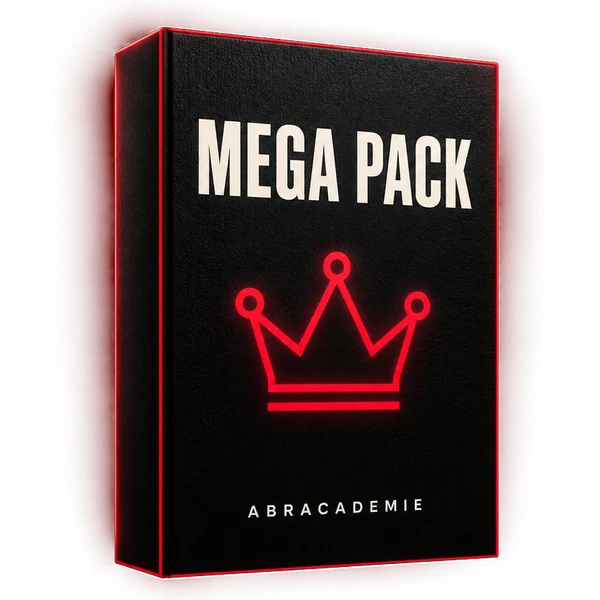 Mega PackEvery Abracademy course in a single pack: magic, mentalism, hypnosis and lucid dreaming.Discover the Mega Pack
You want to do it for a living: professional mentoring
If your goal is to become a professional magician, an online course isn’t enough. You need someone to guide you. That’s the one-year mentoring program to become a professional magician that I run with Hiro.
Hiro is one of the best magicians in France today, and one of the most in demand. A professional magician and lecturer for more than 20 years, he has worked for Yves Saint Laurent, L’Oréal, Chanel, Mercedes and Paris Saint-Germain, and has performed for Tony Parker, Gaël Monfils and Matt Pokora.
What you get: more than 300 professional training videos, private one-on-one and group sessions, ready-to-use shows, the creation of your brand, WhatsApp support for your questions, a community, in-person meetups and a certification at the end.
It’s a demanding program, with very few spots: selection happens on a call. If you want to do this for a living, send your application.
If you’re wondering what that path looks like, from amateur to first gigs, I explain it in my article on how to become a magician.
Still not sure? All my online magic courses are gathered on one page.
What should a beginner learn first?
Whatever course you choose, the learning order is almost always the same:
- Self-working tricks, which work by themselves, with no secret moves. They teach you to present before you learn to handle cards. You’ll find some in my article on no sleight of hand magic tricks.
- Holding and shuffling a deck naturally. It sounds silly, but a magician who’s comfortable with cards already looks credible. Start with a good deck: I explain which one to choose in my guide to the ideal magic deck of cards.
- One or two basic techniques, like the force (getting the spectator to end up with the card you want, while they believe they’re choosing freely) or the double lift (showing two cards as if they were one).
- A few tricks that use those techniques, like the ones in my selection of easy card tricks.
- A small three-trick routine, put together in a logical order, with your script.
I won’t detail the week-by-week program here: you’ll find it in my guide to learning magic on your own, with a first trick to do tonight.
How many hours a week do you need to learn magic?
Good news: you don’t have to give it all your free time. As a hobby, about two hours a week is enough to make real progress, as long as you spread them out well.
- 15 to 20 minutes a day beats two hours straight on Sunday. Moves are learned by repetition, like scales on the piano.
- One moment a week to perform: show a trick to someone, even just one person. That’s where you learn the most.
- One video of yourself a week: film your whole trick and watch it the way a spectator would.
If you’re aiming for paid gigs or the stage, the pace changes. You need to add time to put together a show, rehearse it in full and perform often for an audience.
Choosing your magician course: your next step
A magician course doesn’t do the work for you. It gives you an order, clear explanations and the desire to keep going. The rest is you, your deck and a few minutes a day.
To sum up: books and YouTube to discover, a club to practice in front of people, an online magic course to build your base at your own pace, and mentoring if you’re aiming for a career. Choose a course that explains the method and the presentation, that goes from easy to hard, that lets you rewatch every move and whose teacher really performs for audiences. Run from promises of going pro in a few days.
If you’d first like to see which effects get the biggest reactions, read my article on the most impressive magic tricks. And if you want to try my way of teaching without paying anything, get my free magic course: 7 professional tricks on video, all available right away.
And if your goal is to do this for a living, apply for your spot in the one-year mentoring program with Hiro: it’s the most direct path to becoming a professional magician.
Frequently asked questions
What is the best magician course?
The best course is the one that fits your goal. As a hobby, an online course that goes from beginner to advanced and explains both the method and the presentation is more than enough. To do it for a living, mentoring with follow-up from a professional magician saves you a lot of time.
Can you really learn magic online?
Yes. A video you can pause and rewatch, with a deck in your hands, is often even clearer than a book. The only thing missing is live correction: film yourself to see what your spectator sees, and perform your tricks for real people.
Do you need a degree to be a magician?
No, no degree is required to be a magician. What counts is your level, your show and your experience in front of an audience. Some courses give their own certificate, but you don’t need one to perform.
How much should you practice each week?
As a hobby, about two hours a week is enough, spread over sessions of 15 to 20 minutes a day. Add one moment a week to show a trick to someone. If you’re aiming for paid gigs, you’ll need to spend more time rehearsing a full show.
Are there free magic lessons?
Yes. YouTube is full of explained tricks, and libraries often have magic books. Abracademy also offers a free course: 7 professional tricks on video, which you receive as soon as you sign up.
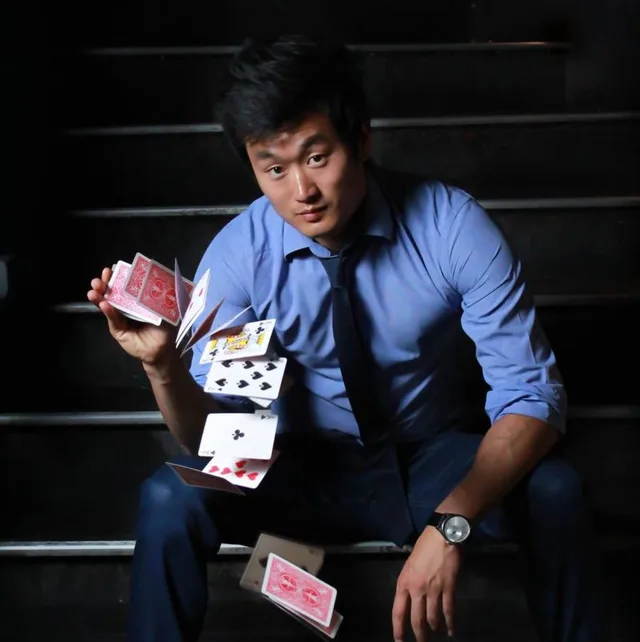 One-year mentoring · very limited spotsBecome a professional magician with HiroHiro is one of the most in-demand magicians in France: Yves Saint Laurent, Chanel, L’Oréal, PSG… With him and Maxime, you have one year to become a professional magician. Students are selected on a call.Send my application